.
Garden Diary - September 2026
All content included on this site such as text, graphics and images is protected by U.S and international copyright law.
The compilation of all content on this site is the exclusive property of the site copyright holder.
Sorghum
various dates
Living as I do in a semi-rural area of western New Jersey (close enough to the Delaware River that Pennsylvania is in sight) there are crop fields filled with corn and soy beans, hay, and such seasonal specialities as pumpkins and Christmas trees.
Every now and then I see something different.
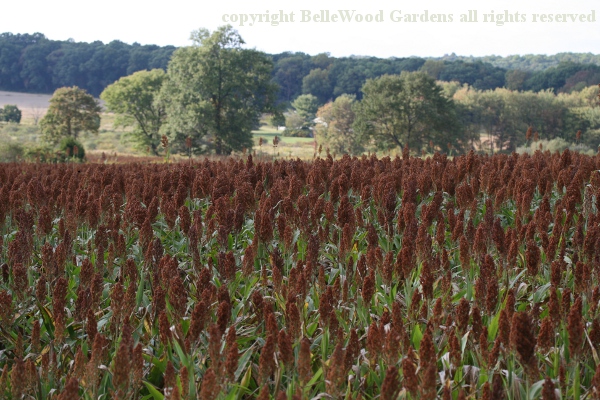
It looks somewhat like corn but not quite like corn. Also a grass in the family Poaceae,
sorghum is known as broomcorn, great millet, Indian millet, Guinea corn, jowar, or milo,
grown worldwide mostly as a drought-resistant cereal grain serving as a major food staple.
Grain Sorghum
Elsewhere in the world sorghum is eaten as whole grain (much as we use rice.) It is unfamiliar for most of us. Bob's Red Mill is a brand offering white sorghum in 24 ounce packages, noting that it can be used in pilafs or popped like miniature popcorn. They also offer it ground into gluten-free flour. Found this bag of Bob's Red Mill sorghum flour in Shoprite of Flemington. Doesn't mean it will be easy to find in local supermarkets. For example the Shoprite in Clinton does not carry it.
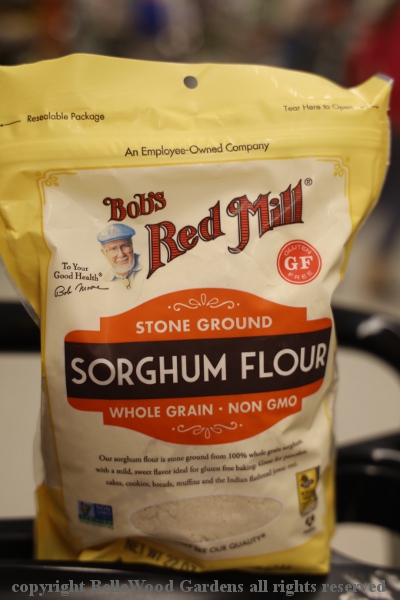
Sorghum, Sorghum bicolor, varieties are categorized into distinct types based on how they are used. These include grain, as was already mentioned. Most milo is used to feed livestock, such as pigs, cattle, and poultry.And much is exported to countries like China and Mexico.
Grain sorghum is often used as an inexpensive, bulky, starch-rich component of wild bird seed mixes. Be aware that popular backyard birds like cardinals, finches, titmice, and chickadees generally dislike sorghum. They kick it out of feeders to search for seeds they prefer, such as sunflower. Ground-feeding birds such as mourning doves will eat the fallen sorghum.
While I was in Kingwood Feed and Mercantile recently I started talking with a woman who came in for multiple bags of feed and bedding for her goats. Casually, I asked if she had ever grown sorghum. Turns out yes, she had. The first crop was excellent, not so good in subsequent years. However there were two issues. It is very "dirty," that is it is dusty to harvest. And the place that wanted to buy it was in Pennsylvania, so transportation was an issue.
Sorghum for Livestock Forage
Turning livestock into a field after harvesting grain is nothing new. It's sort of gleaning, by livestock or poultry rather than people. Purposely grazing Sudan grass, Sorghum drummondii, is not a common practice here in the United States. Allow it to reach the 8- to 10-leaf stage before grazing or it doesn't produce much forage.
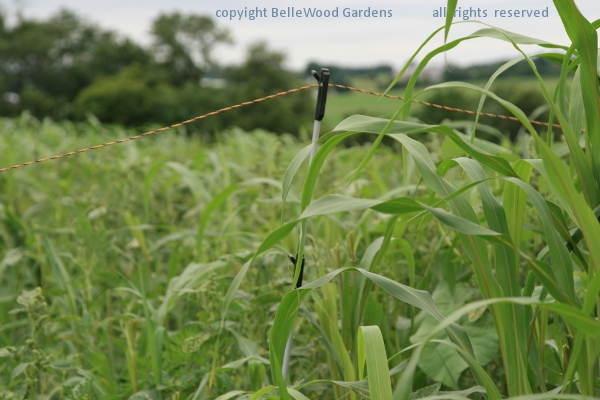
Simple electric fencing divides the strips where the cows can graze.
Shift the fencing, and that moves the cows to a new area.
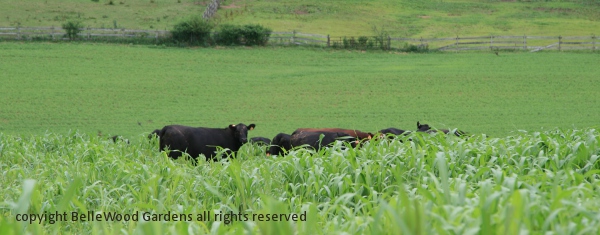
Sudan grass is a hybrid-derived warm weather species native to tropical and subtropical regions of Eastern Africa raised for forage and grain. It performs best in years when the growing season is characterized by higher than average temperatures. Sudan grass can be grazed any time after the plant has reached a height of 18 inches, usually 5 to 6 weeks after planting. Grazed in its early vegetative stage it contains as much available energy as corn silage and considerably more protein.
Sweet Sorghum
And then there is sweet sorghum, grown for making sorghum syrup.
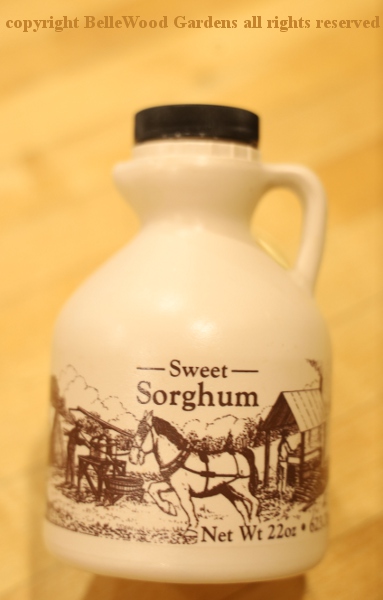
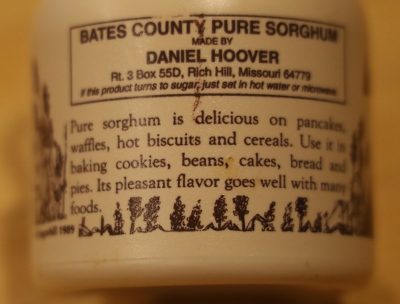
Harvested for the stalks rather than the grain and crushed like sugarcane to produce a syrup.
Sweet sorghum was once the predominate table sweetener in the southern United States, especially Louisiana. Today, sweet sorghum is used as a healthy alternative sweetener, and also to produce whiskey and rum type products. There are two cultivars dominantly used for making syrup. They are 'Dale', a classic 10 to 12-foot-tall variety developed in 1970 with a high sugar content, resistant to leaf anthracnose.The other is 'Rox Orange', a popular heirloom variety featuring sturdy stalks and a fast maturity window of roughly 70 to 80 days.
Broomcorn
Rather different from anything you might have thought of, in conjunction with sorghum. The use of sorghum panicles to make besoms. Or brooms, might be a more familiar name.
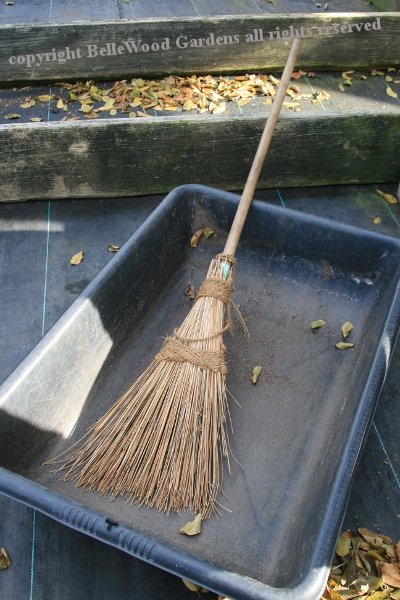
The long, straight, wiry stalks and tassel fibers form the sweeping part of a broom. Called the hurl, these fibrous top portion and stalk of the broomcorn plant are the part of the sorghum's panicles that are going to be turned into a broom once the seeds are removed. Threshing before curing results in better quality brush because the fine branches are less likely to be knocked off when the brush is still moist and flexible. Broomcorn produces heads with fibrous seed branches that may be as much as 36 in. long. A small hearth or whisk broom needs about 45 total heads. A standard round broom takes even more, about 10 larger stalks attached to a handle for core/inner layers, scaled up with additional outer layers.
There were several besoms at this open hearth cooking event.
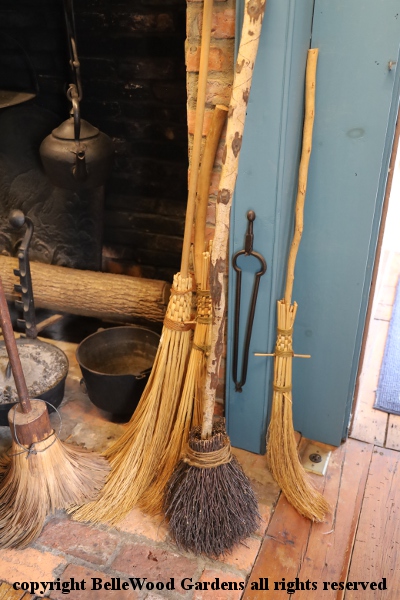
Standing on their bristles is really a very poor way to leave a besom.
It flattens the fibers, and bent bristles makes the broom sweep poorly.
Sorghum for Biomass
Bred to produce a large amount of non-grain biomass, this type of sorghum is the tallest, most massive of all the sorghum varieties. It reaches a height of 20 feet in a normal growing season. These hybrids are used primarily for the production of bioenergy, with a large portion of the harvest going into making renewable fuel and ethanol.
If you have any comments or questions, you can e-mail me: jgglatt@gmail.com
Back to September
Back to the main Diary Page