.
All content included on this site such as text, graphics and images is protected by U.S and international copyright law.
The compilation of all content on this site is the exclusive property of the site copyright holder.
Call It Greensward, or No Mow May
Thursday, 21 May 2026
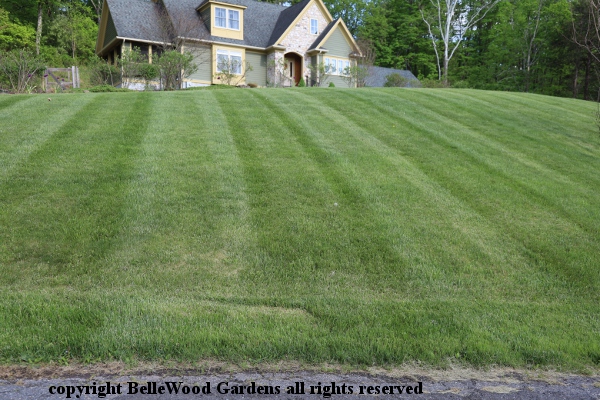
Greensward, a term more elegant than lawn, has other synonyms including turf, sod, and verdure. It has a connection to Central Park. Olmsted and Vaux believed in creating “scenery” that appeared to be natural. They felt that the park “should present an aspect of spaciousness and tranquility, with variety and intricacy of arrangement, thereby affording the most agreeable contrast to the confinement, bustle, and monotonous street-division of the city.” They named their plan “Greensward,” a word that means ground covered with green grass. Visitors today can easily observe how the designers reserved large areas of the park for pastoral scenery with open greenswards bordered by shrubberies and groves of trees, often with nearby open water to reflect foliage and give a feeling of depth to the landscape.
Decades ago we had a neighbor in Norwalk, Connecticut who had a small, pristine front lawn that looked as if it were a demonstration for Scotts turf grass. Immaculately green, weed free, precisely watered, fertilized, mown. If I was nice and polite I would occasionally be allowed to walk barefoot on this carpet of bluegrass.
That was then. This is now. Today there are concerns about chemicals in the landscape, impact on pollinator insects, and other concerns that influence the landscape. “No Mow May” is a quick and catchy name for a movement that aims far beyond not mowing the yard for a month. It’s more than long grass and dandelion blooms. It’s a gateway to understanding how we share our lawns with many small creatures.
Just allowing weeds to grow is somewhat better than no flowers, but the typical lawn weeds may not be the best for bees, or the best neighbors to other flowers. Dandelions, for example, have pollen that is low in protein (poor nutrition for bees) and is known to suppress other flowers.
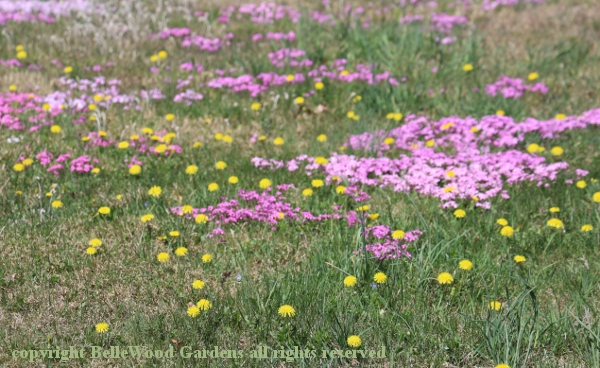
Dandelions and Phlox subulata in the Mt. Salem Methodist Episcopal churchyard.
You can go beyond reduced mowing by changing your lawn to include more flowering species.
A “bee friendly lawn” may include white clover, Trifolium repens. In fact, all those decades ago
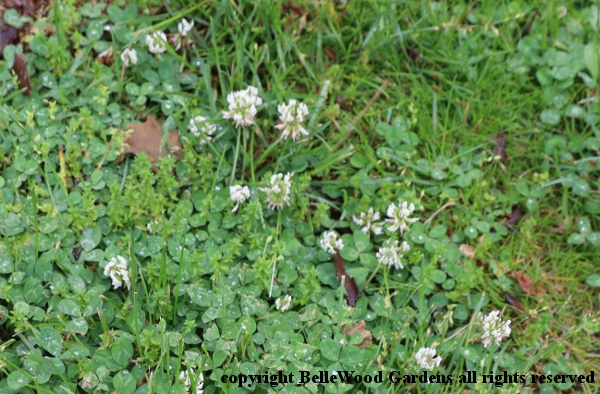
when I worked at Libner Grain in Norwalk we sold bulk grass seed mixed with white clover.
Why did we do that? Because white clover is a legume that fixes nitrogen into the soil.
Grass needs nitrogen, and it is more efficient to grow nitrogen rather than manufacture it.
Other low-growing flowering plants such as native violets, Viola spp.
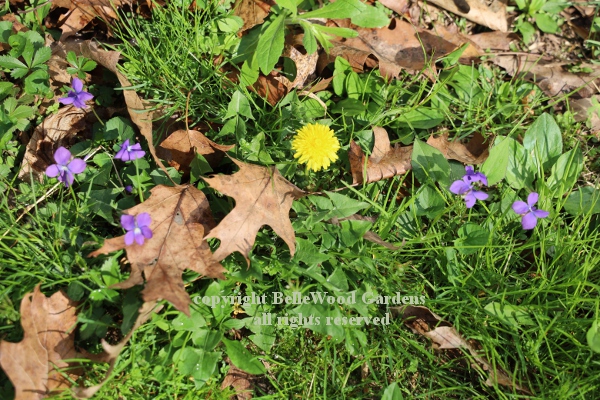
might already be present. Encourage them as valuable host plants for fritillary butterflies.
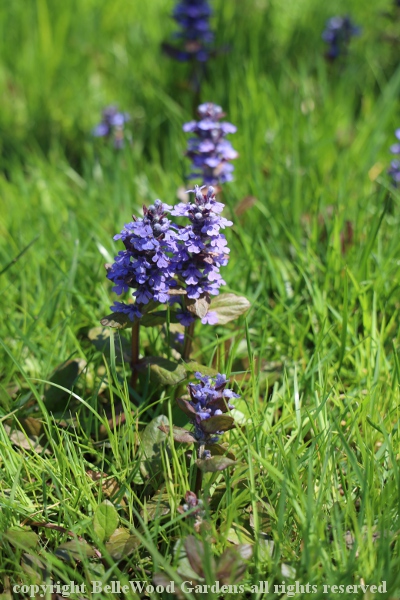
Remember the Phlox subulata in the churchyard? Others such as creeping thyme, Thymus spp., selfheal, Prunella vulgaris,
 .
.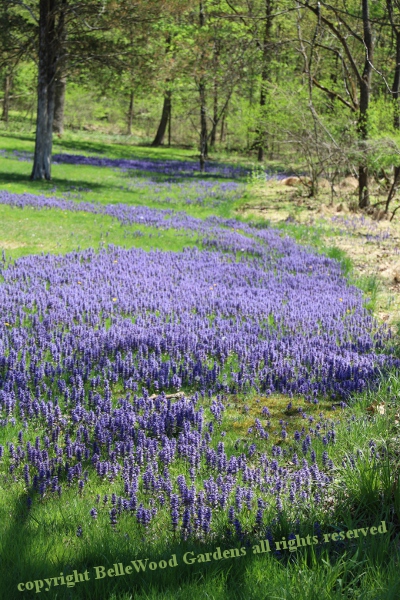
and more, such as Ajuga repens, become a showy floriferous mass that post-bloom accept mowing all summer long.
Another option for spring would be little bulbs planted in the lawn. They will, over time,
increase and provide a more natural appearance. To begin, though, plant in a spiral and
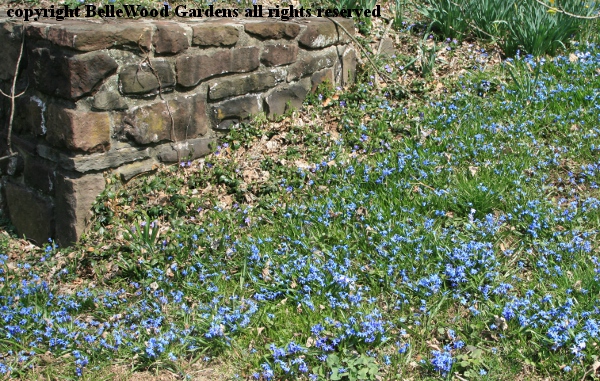
not in rows. Possibilities include Scilla siberica, seen here with a few Chionadoxa.
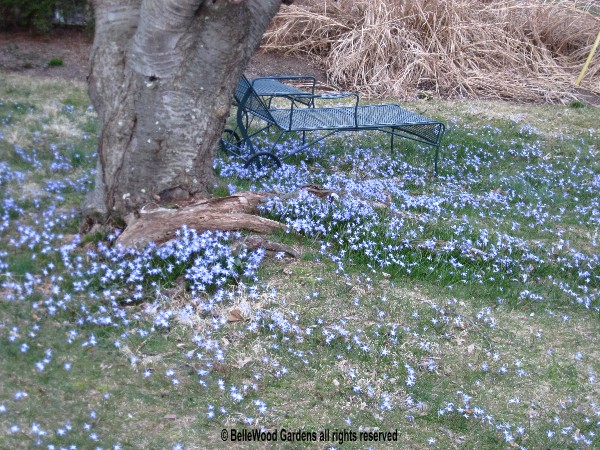
Or, enjoy established chionodoxa in a Frenchtown lawn, massed under lawn furniture
Crocus are also popular. Do not mow the grass until bulb growth yellows and fades.
Lawns certainly have their place for some activities. For homes, I think of picnics, kite flying, sun bathing. Golf requires even more specialized turf than a mere lawn. While people used to play lawn tennis that has become a rarity. But how much lawn you really need, and to what standard must it be maintained - that is the question.
If you have any comments or questions, you can e-mail me: jgglatt@gmail.com
Back to May
Back to the main Diary Page